Friday, August 11, 2006

Selling Human Organs Pro And Cons

10 tips for a stress free back

Top

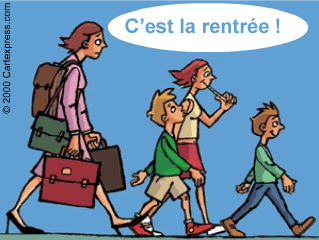
Your child has spent more than two months have fun, to live at their own pace and do virtually what he wanted. Find the stresses of school, do not necessarily packs ... Also, from what little difficult hurdle, he will need you to be a bit more available than usual and surrounds you with all your affection. Here are 10 tips for back stress free.

1 - Get him used to new schedules

After the lazy mornings and summer evenings, your child needs to find a new rhythm. A few days before school starts, move her bedtime and that of sunrise. Ideally, bedtime should not exceed 21 hours, even allowing half an hour of reading in bed.

2 - Prepare the psychologically

In the days before D-day, tell him to school. Explain why there is and what benefits it will derive. Your argument will have to adapt to the character and age your child is going to find his friends and make new ones, discover new activities, learn things that will help it grow ...

3 - Reassure

He is anxious, and when you him talking about the comeback, he whines, "No, I do not want to go! "It's normal. Tell him you understand his anguish as it will change master, class ... and at his age you had you a few days back apprehensions, but you've made many friends. Explain that in case of difficulty, you will be at her side to help to overcome them.

4 - Prepare it to be self

Especially with the toddler, the lack of autonomy can create a real stress. To avoid him, teach him to undress and get dressed alone. To help identify his clothes with labels sewn on his name or initials can easily identify it. In addition, it will avoid the confusion that frequently because it is not uncommon for two children wear identical clothing.

5 - Be sure to carry out routine medical checks

Vision, hearing, teeth, vaccinations. This is important for your child's future because it is common for a child to become a "bad student" solely because of poor eyesight or hearing fails. How to find out if it is not clear or if you do not hear correctly what the teacher says?

6 - If your child comes to kindergarten, or if he changes schools (sixth passage, moving ...)

Do not wait until D-Day to present his new school. Nothing more scary than a place without reference in which he will feel lost. To familiarize with the place, made the trip several times with him while explaining where the court, classrooms, the playground ... If there are "open days", take him to visit the school, it will help to create new markers and have confidence in him the first day of school.

7 - Buy her books on school

And especially on the back. Children love to identify with "heroes" of these educational materials. Besides, it's reassuring that others are also anguished cry or D-Day Especially since it always ends well!

8 - Make him a small bag or briefcase with her personal belongings (clothes for children, travel card if necessary ...)

Drag it as something he particularly likes (a blanket, he collects pictures, a toy ...). This will reassure him to bring a little piece of him with his usual environment.

9 - D-Day

Wake up early enough to avoid being too "speed". He must have the time to wake up and take a good breakfast. If he has no appetite because it is distressed, do not insist, but make him a snack (cheese sandwich, cereal bar, fruit ...) that you slip into his satchel.

10 - Join the school

If you have the possibility (and if he wants!), Accompany your child to class. If you can not accompany him, but do not blame him explain things well and try to leave earlier at night so he could tell you his first day of school!
10 questions about whether the back stress your child

1 - Does your child complains of stomach pains, cramps or poor digestion during the first days of class?

2 - Refuse there to go to school for various reasons and he cries about it?

3 - Is it for insomnia at the start of classes?

4 - Frequent Does a new school this year?

5 - Is it junior or between primary there in Secondary?

6 - Your child is he afraid of friends at school or in the classroom?

7 - Did he see significant changes in his family?

8 - Is it not very talkative when it comes time to recount his days at school?

9 - Does he have cold sweats, palpitations and even breathing difficulties during the first days of class?

10 - Does it tend to be agoraphobic, that is to say not to feel at ease in public?

If you answer yes to one or more of these questions, try to find out if your child may be distressed by her first classroom to help them better adapt.
End


References
http://www.doctissimo.fr/html/psychologie/psycho
_pour_tous/enfant_bebe/ps_2181_stress_rentree.htm


http://www.petitmonde.com/iDoc/ EnBrefUnique.asp? id = 22045 &

More ...
http://www.webdlambert.com/rentree.html # help

http://www.fgiworld.com/headlines/back_
to_school / la_rentree_scolaire.pdf

Wednesday, August 2, 2006

Female Beach Volley Camel Toe

Educating without punishment, it is possible

Top

Parents have a duty to educate their children. They have the difficult task of guiding the young child to allow him to gradually acquire autonomy and becoming an adult individual and a responsible citizen.

Yet, this broad agenda is not always easy to accept and young parents are often poor at a very young child who can only react by expressing his opposition, making anger or crisis.

It starts even before the child acquires language and many young parents, exhausted resources, mean well by giving pats on the buttocks or hands of small children on the pretext that he does not understand anything.

Then when the child grew, they gradually establish, always believing Ideally, a system of punishment-reward "Thou shalt have it if you do that or if you do not do that." In this cycle, the emotional blackmail often occupies the first place: "If you love me you must obey me, do this or that."

This system, which may give the illusion of being an effective time, that would be not to get the latest game-boy, still shows its limits very quickly. It's give and take and the child realizes very quickly that this game, it holds tremendous power over their parents. Soon, we will not know who is the blackmailer: parents or child.

Anyway, the parents are often confronted with a dangerous escalation in their wallets and family balance.

The mental health of the child is also being undermined in that the child empties his wishes as and when his parents give him everything he wants. The cons-part of this escalation is a feeling of omnipotence that can invade the child's belief that it is he who dictates his law his parents by imposing such a purchase or another or by forcing them to follow his will: outings, dating ...

In this dysfunctional family, generational benchmarks which the child needs to build, become confused.

Some parents, aware of the excesses of their education systems do well to think back on track, spanking, slapping or even threaten the whip. To exonerate himself, they say: "Previously, we educated the children like that!". Or: "That's how I was raised and it did not hurt." This page

aims to help parents who are committed without noticing in these educational impasses which they would like to go out. It also aims to participate in the evolution of our society is towards more respect for the personality of the child.

But how to educate without punishment?

natural authority
Many parents who use these educational attitudes do lack confidence in their own authority. Concerned parents must first be convinced that they can assume their parental role without resorting to threats worthy of another age. If necessary, they should not hesitate to seek advice from various associations or consult a psychologist. This can help them adhere more vigorously to their role as parents. Some cities provide meeting places for parents with young children, such as "Green House" created by Dolto. In these places, children playing under the gaze of their parents. Professionals in early childhood are present to respond if necessary, to questions from parents who wish to be guided in their educational role. Trade between the parents themselves, the difficulties of each other, can also provide effective support. Knowing that we are not alone in having encountered such kind of problems can be reassuring and help them in perspective.

child who always says no
All young children go through a phase of opposition. Say "no" to the young child is often the first manifestation of his individuality. If it disagrees with his parents to better assert its personality. However, parents should not feel threatened in their authority when the toddler contest. By cons, what they will do this opposition is theirs. To them to explain why such a ban or such obligation. Whatever the age child, it goes through the floor first. Everything must be explained to the toddler in the language most appropriate. The simplest message is often that the child will understand it better. "You gotta go to bed now because you're tired" "You can not eat this because it would make you sick" "You must give your toys if you want to have friends" "Thou shalt not take the neighbor's toy without asking him if he agrees. "

course, in the period following the acquisition of walking, parents sometimes feel disadvantaged because their child who has not yet mastered the language, wants to explore its environment at the risk of large nonsense. But it is by speaking with the child he will acquire language. In any event, the child understands many things before they can articulate. Anyway, rather than patting when the child is in danger, it is for the parents to ensure that the situation is not dangerous for the child. Young children are constructed by identifying with adults, so if you type your child, do not be surprised to see, then, do the same to you. This type of relationship that develops often at an early age will be when the child grows, although difficult to correct.

When the child grows
educate a child without punishment must remain the goal of all education.
The principles of early childhood remain valid and will be even easier to implement them have been the basis of the relationship with the infant child.

That is still and always explain why educational principles, which should aim to empower the child to his own fate: "You work for you if you try hard, when you grow up, you able to do a job that pleases you. "

The parent also show the right path for citizenship: respect the other, respect for difference. All values are also listed in the school. All involved in education must indeed have a speech and actions consistent so the child can join the speech and put it into action.

course, there will be missed in this system without punishment, but when the child will be listed in order, the prevailing notion of reparation on the concept of punishment.

Repair
When there is a breach of the educational principles into effect, whether at school or at home, it will still have recourse to language. Speak with your child
to understand the context, the sequence of events leading to the wrong action. Often, the child believes to be within its rights in good faith. Help them understand the consequences of his act to better prevent recidivism.

Apologize to the man who was injured is often a good way to repair the "outrage".

If the damage is physical, one can imagine a way to repair the damage to compensate. Help the child to repair it is also feeling guilty over the wrongdoing.

However, the role of parents is still to make him aware everything is still serviceable, and it will be less and less as and when it will grow and become teenagers.

In any event, when the child seems to enjoy stupidity on stupidity, it must alert parents. The child often expressing unease through this repetition. This is often the only way that allows him unconscious to tell his friends that something is wrong. The consulting service specializing in child psychology is so often the preferred solution.
End

References
http://perso.orange.fr/genevieve.cavaye/puinitions.htm

For further reading:
Jacqueline CORNET, Should we beat children?, Ed . Males and perspectives, 1997.
Sophie Guillou, "For a new authority of parents without the return of the stick", Milan, 1999.
Maud Mannoni, "Education impossible", Seuil, 1973.
Alice Miller, "Freedom of Knowledge", Flammarion, 2001.
Olivier Maurel, "spanking", ed. The Beach.
Eirick Prairat, "Sanction and socialization", PUF 2001. Eric
DEBARDIEUX, "Violence in the classroom," SFS 1990.